
The History and Development of the Fulton MX-991/U Right-Angle Flashlight
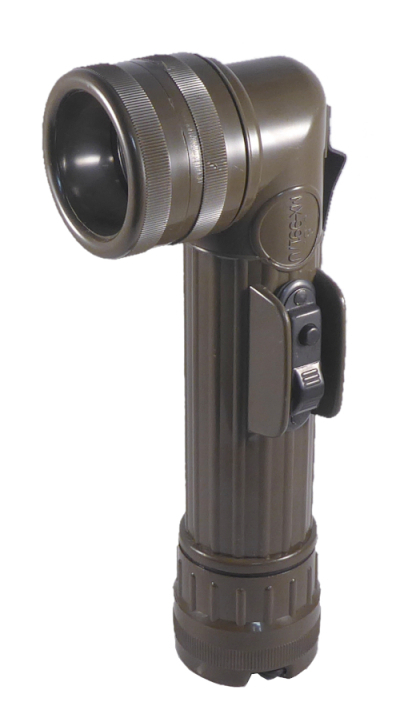 The Fulton MX-991/U right-angle flashlight, commonly called the GI flashlight, Army flashlight, or Moonbeam, is one of the most recognizable pieces of American military field equipment ever produced. Its unusual 90-degree configuration, olive-drab housing, equipment clip, colored filters, signaling switch, and simple mechanical construction have remained remarkably consistent for generations.
What makes the MX-991/U particularly interesting is that its history goes back much further than the Vietnam War. The flashlight used by American soldiers in Vietnam was the product of more than two decades of development that began with the early military angle-head flashlights of the World War II era. The modern Fulton N47 is the latest production version of that lineage. The same basic concept that evolved during World War II is still being manufactured today.
Table of Contents
- Origins of the Right Angle Flashlight
- The Birth of the TL-122 Military Flashlight
- The TL-122A and the Move Toward a Military Design
- The TL-122B and the Switch from Brass to Plastic
- The TL-122C and Improved Waterproofing
- The TL-122D Adds Filters and Signaling Capability
- From the TL-122D to the Postwar Military Flashlight
- The MX-99/U: The Direct Predecessor to the MX-991/U
- The Development of the MX-991/U
- The MX-991/U During the Vietnam War
- Why Later MX-991/U Flashlights Have Switch Guards
- Who Manufactured the MX-991/U?
- The Design Features That Made the MX-991/U Successful
- Why the MX-991/U Has Colored Filters
- From Vietnam to Modern Military Service
- The Modern Fulton N47
- Replacement Parts Keep Older MX-991/U Flashlights in Service
- The MX-991/U Enters the LED Era
- Shop Fulton MX-991/U and N47 Flashlights and Parts
Origins of the Right Angle Flashlight
The right angle flashlight was not invented specifically for the U.S. military. Angle-head flashlights were already being produced commercially before World War II. Historical references to the military TL-122 series trace the design to commercial angle-head flashlights such as the Eveready Model 2694 Industrial flashlight and Model 2697 Boy Scout flashlight, which date to the late 1920s.
These early flashlights established the fundamental configuration that would eventually become the familiar military "crookneck" or right-angle flashlight: batteries were carried in a body held perpendicular to the direction of the beam. That configuration offered an important advantage over a conventional straight flashlight. The light could be clipped to clothing or equipment while the beam remained directed forward.
For a soldier carrying a rifle, ammunition, tools, communications equipment, or other gear, being able to illuminate an area without continuously holding a flashlight was a significant practical advantage. As the United States prepared for World War II, the military adapted this commercial concept into a standardized field flashlight.
The Birth of the TL-122 Military Flashlight
Just before World War II, the U.S. Army adopted the TL-122 as a standard right-angle flashlight. The TL-122 represented an important change in the role of the flashlight. Instead of being simply a consumer lighting product, it was now being designed around the requirements of military service.
The original TL-122 used a metal housing and a screw-base bulb. The body was configured to be carried on military equipment, and the flashlight was finished in the olive-drab color associated with American military equipment.
The basic right-angle configuration solved one of the most important problems with carrying a flashlight in the field: how to keep illumination available without tying up a soldier's hand. That would remain a core concept through every subsequent generation of the flashlight.
The TL-122A and the Move Toward a Military Design
The TL-122A represented an early refinement of the military angle-head flashlight. Introduced in 1939, it retained the basic brass construction of the earlier design while incorporating improvements intended to make the flashlight more useful under military conditions.
One of the important changes was improved waterproofing. The flashlight also used a brighter PR-series flange-base bulb and was designed to fit brackets used in military vehicles.
The evolution of the TL-122 series illustrates an important principle that would continue throughout the MX-991/U's history: Fulton and other military flashlight manufacturers were not continually reinventing the flashlight. Instead, they were making targeted improvements to an already useful design. The right-angle body worked. The equipment clip worked. The basic two-cell configuration worked. The challenge was making those features more durable and more resistant to the conditions soldiers encountered.
The TL-122B and the Switch from Brass to Plastic
One of the most significant changes came during World War II with the TL-122B. The TL-122B introduced a plastic housing, replacing the earlier metal construction. This was an important development because materials had become a major consideration during wartime production.
The transition to plastic also demonstrated that a military flashlight did not need to be heavy to be durable. The TL-122B was produced from a molded plastic material commonly identified as Bakelite in historical references. The design retained the familiar right-angle configuration while making the flashlight lighter and easier to manufacture.
The move from brass and other metals toward plastic was more than a wartime manufacturing compromise. It established the basic construction philosophy that would eventually lead to the modern MX-991/U. The familiar military right-angle flashlight was becoming a lightweight molded-plastic piece of equipment rather than a miniature metal lantern.
The TL-122C and Improved Waterproofing
The next major development was the TL-122C, introduced during 1944. The TL-122C further refined the plastic construction and improved the flashlight's resistance to moisture. The lens, battery cap, and switch were better sealed, bringing the design much closer to the waterproof military flashlight that would eventually become the MX-991/U.
Water resistance was especially important for military equipment. A flashlight that worked perfectly in a warehouse could become useless after exposure to rain, mud, humidity, or wet equipment. Instead of relying on complex electronics or elaborate construction, the TL-122 series addressed the problem with straightforward mechanical improvements: better seals, improved materials, and protected components.
The TL-122D Adds Filters and Signaling Capability
The TL-122D, introduced late in World War II, was one of the most important steps in the development of the modern military right-angle flashlight. The TL-122D incorporated an extended base that could store colored filters and a spare bulb. This seemingly simple addition transformed the flashlight from a basic illumination device into a more versatile military signaling tool.
Colored filters could change the appearance of the beam for signaling and specialized illumination. The flashlight could also be operated momentarily, allowing it to be used for coded signals rather than simply being left continuously illuminated. The filter storage system is particularly important because it established a feature that would survive into the MX-991/U.
Look at a modern Fulton N47 MX-991/U right-angle flashlight and one of the first things you will notice is the compartment at the bottom of the flashlight. Open it and the connection to the World War II-era design becomes obvious: spare lighting components and colored filters are stored inside the flashlight itself. Many of its defining characteristics were already established during World War II.
From the TL-122D to the Postwar Military Flashlight
After World War II, the military continued using and refining the right-angle flashlight concept. The TL-122 family had proven that a lightweight, right-angle flashlight could be manufactured in large quantities and survive demanding field conditions.
The next generation focused on improving the housing, waterproofing, battery contacts, reflector, and accessory storage. The result was a flashlight that looked increasingly similar to the model most people now associate with Vietnam-era American troops. The important transition occurred around the beginning of the 1960s, when the military standardized the next generation of the design.
The MX-99/U: The Direct Predecessor to the MX-991/U
The MX-99/U is an important but often overlooked part of the flashlight's history. The MX-99/U was approved as a military design in 1960 and received the National Stock Number 6230-00-264-8261. Quantity service deployment began in 1963, and the MX-99/U entered military service as American involvement in Vietnam was increasing.
The MX-99/U represented a substantial refinement of the wartime TL-122D design. It retained the two-cell battery configuration, right-angle body, equipment clip, signaling switch, spare bulb, and colored filters, but incorporated a more modern high-impact plastic housing.
Several changes were particularly important:
- Improved high-impact plastic construction
- Improved waterproof gaskets
- A plated steel battery spring
- A reflector recessed farther into the head
- An extended base for storing filters and a spare bulb
- Continued use of the military two-cell battery configuration
The designation "/U" is generally associated with the flashlight's waterproof or underwater specification.
The Development of the MX-991/U
The MX-991/U followed the MX-99/U during the Vietnam era. The MX-991/U retained the same National Stock Number used by the earlier MX-99/U design, an evolution of the existing military flashlight rather than a completely different product. This explains why the MX-991/U looks so similar to the TL-122D and MX-99/U. The military had already arrived at a configuration that worked extremely well.
The MX-991/U retained the features that had evolved over the previous two decades:
- Right-angle configuration
- Two-cell battery power
- Plastic housing
- Equipment clip
- Spare bulb storage
- Colored filters
- Momentary signaling capability
- Water-resistant construction
- Simple mechanical controls
The MX-991/U During the Vietnam War
The Vietnam War cemented the MX-991/U's place in military history. The flashlight was standard equipment for American soldiers and became particularly recognizable because of its olive-drab right-angle body and distinctive profile.
Vietnam was an especially demanding environment for field equipment. Soldiers dealt with heavy rain, humidity, mud, dense vegetation, darkness, and difficult terrain. Equipment had to continue working despite those conditions. The MX-991/U's relatively simple construction was an advantage in that environment. There was little to go wrong electronically, and the major components could be replaced.
The flashlight also made sense tactically. A soldier could clip it to his equipment and use it without dedicating a hand to holding a conventional flashlight. Its signaling capability was equally important. The Signal position allowed momentary activation of the bulb, making the flashlight useful for controlled communication and Morse-code signaling.
Military references and accounts from the period also explain why later versions of the design acquired additional protection around the switch.
Why Later MX-991/U Flashlights Have Switch Guards
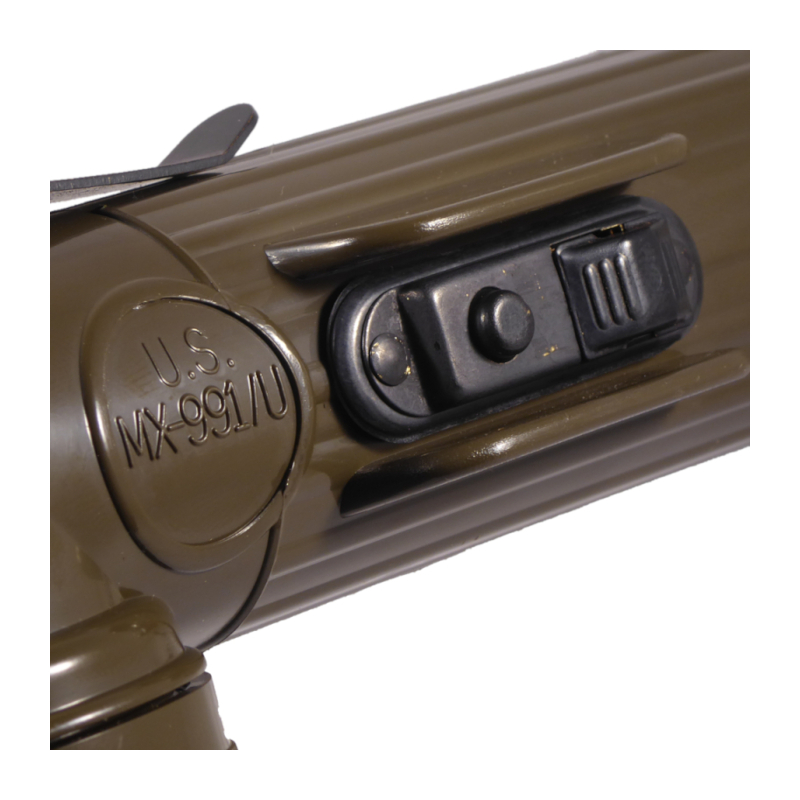
If you compare early and later MX-991/U flashlights, one of the most obvious differences is the switch guard. Early versions have a relatively exposed sliding switch. Later versions have raised guards on either side of the switch that help prevent accidental activation. The change was not simply cosmetic.
During field use, equipment and clothing could contact the switch and accidentally move it into the On position. In a military environment, that could drain the batteries when the flashlight was supposed to be stored. A specification change in 1973 added protection against accidental switch activation, and switch guards subsequently became part of later MX-991/U production.
This is a good example of how the MX-991/U continued to evolve even after the basic design had already been established. The military did not need to redesign the entire flashlight. A relatively small change to the switch area solved a specific field-use problem.
Who Manufactured the MX-991/U?
Another interesting aspect of the MX-991/U's history is that Fulton was not the only manufacturer of the flashlight. Over the years, military-contract versions of the design were produced by several manufacturers, including Fulton, GT Price, Bright Star, and USALite.
This is important for collectors because an older MX-991/U that does not carry a Fulton marking can still be a genuine military flashlight. Older MX-991/U flashlights can be found from multiple manufacturers, but Fulton is the only current manufacturer contracted to produce the MX-991/U for the U.S. government.
The MX-991/U is currently manufactured by Fulton as the N47.
The Design Features That Made the MX-991/U Successful
- Right-Angle Head - The 90-degree head allows the flashlight to be clipped to clothing or equipment while pointing the beam forward. This provides hands-free illumination without requiring a head strap.
- Two-Cell Battery Configuration - The flashlight was designed around two military D-cell batteries, providing a simple and widely available power source.
- Mechanical Switch - The three-position switch provides Off, Signal, and On modes without complicated electronics.
- Spare Bulb Storage - The flashlight incorporates storage for a spare bulb, allowing a failed lamp to be replaced without carrying a separate container for the replacement.
- Colored Filters - Filters provide different lighting and signaling options while allowing the same flashlight to perform several specialized functions.
- Waterproof Construction - Gaskets and sealed components protect the electrical system from moisture, an essential characteristic for equipment expected to operate outdoors.
- Replaceable Components - The bulb, filters, lenses, and seals can be replaced. This greatly extends the useful life of the flashlight.
Why the MX-991/U Has Colored Filters
The colored filters are one of the most recognizable features of the military right-angle flashlight, but they are often misunderstood. The filters were not included simply to make the flashlight more versatile for recreational use. They were developed around military signaling and field-illumination requirements.
A red filter, for example, can be useful when working in darkness because red light can help preserve dark adaptation better than bright white illumination. Other colors can be used for signaling or to make specific objects easier to see under particular conditions.
Replacement filters are also still available. The Fulton MIL-REPL Replacement Parts Kit includes replacement lenses, filters, gaskets, O-rings, and a spare PR6 bulb.
From Vietnam to Modern Military Service
The end of the Vietnam War did not mark the end of the MX-991/U. The flashlight continued serving through subsequent decades and military operations. Fulton describes its military flashlight heritage as spanning World War II, Korea, Vietnam, Desert Storm, Iraq, and current military service.
That is an extraordinary service life for any piece of equipment.
The reason is not that the MX-991/U remained technologically advanced. It did not. Instead, the flashlight remained functionally appropriate. A soldier still needs a small light that is durable, easy to operate, easy to carry, resistant to water, and capable of controlled illumination. Those requirements did not disappear simply because brighter electronic flashlights became available.
The MX-991/U also has an advantage that many modern electronic products do not: it can be maintained. A damaged lens can be replaced. A worn gasket can be replaced. A burned-out bulb can be replaced. The flashlight can continue working for years without becoming dependent on proprietary electronics or a sealed rechargeable battery.
The Modern Fulton N47
Today, Fulton Industries identifies the current version of the classic MX-991/U design as the Fulton N47. The modern N47 retains the familiar characteristics of the military flashlight while using current manufacturing materials and processes. The current Fulton N47 uses a heat- and corrosion-resistant plastic housing, a three-position black-oxide brass switch, two D-cell batteries, and a PR6 bulb. It also retains the colored filters, spare bulb storage, equipment clip, and waterproof construction that define the traditional design.
The Fulton N47 MX-991/U OD Green Right-Angle Flashlight is current production and is made in the USA. BJL Outdoors sources these lights directly from Fulton Industries and distributes them worldwide. These are not modern imported reproductions made to resemble the Vietnam-era flashlight. They are current Fulton products based on the same military design lineage.
For customers who prefer black, BJL Outdoors also carries the Fulton N47-3 MX-991/U Black Right-Angle Flashlight.
Replacement Parts Keep Older MX-991/U Flashlights in Service
 The fact that replacement parts remain available is one of the most important reasons the MX-991/U can have such a long useful life. An older flashlight may have a perfectly good housing and switch but suffer from deteriorated rubber seals, a cracked lens, missing filters, or a burned-out bulb. Those problems do not necessarily mean the flashlight has reached the end of its useful life.
The Fulton MIL-REPL Replacement Parts Kit is designed for Fulton military-specification flashlights including the MX-991/U and MX-993/U. The kit contains replacement waterproof gaskets, O-rings, lenses, filters, a diffuser, and a spare PR6 bulb. It provides a straightforward way to restore an older flashlight without replacing the entire unit.
BJL Outdoors also offers individual Fulton replacement components through its Fulton Flashlights category, including PR6 incandescent bulbs, PR-LED bulbs, reflectors, and other Fulton accessories.
For someone restoring an older military flashlight, these relatively inexpensive components can make the difference between a collectible that sits on a shelf and a functional piece of equipment.
The MX-991/U Enters the LED Era
The biggest technological change to the MX-991/U has been the transition from incandescent lighting to LED technology. The flashlight originally used a PR6 incandescent bulb. That bulb is part of the historical character of the flashlight and remains available for people who want to maintain the original configuration.
Modern LED technology, however, provides several advantages, including increased brightness, reduced power consumption, and substantially longer bulb life. Fulton now offers LED components for compatible military right-angle flashlights. Anybody can therefore have the historical appearance and mechanical simplicity of the classic military flashlight while taking advantage of modern LED technology.
BJL Outdoors carries the Fulton MIL-LED-REPL LED Replacement Parts Kit, which includes a Fulton PR-LED replacement bulb along with replacement filters, diffuser, clear lens, O-ring, and gaskets.
For customers who want only the bulb upgrade, the Fulton PR-LED replacement bulb is also available separately. For those looking for the original incandescent bulb, BJL Outdoors carries the Fulton PR6 replacement bulb for compatible Fulton flashlights.
BJL Outdoors also offers the Fulton N47 MX991/U Military Flashlight Rebuild Kit. This kit combines replacement components with an LED upgrade and D-to-AA battery adapters.
Shop Fulton MX-991/U and N47 Flashlights and Parts
The Fulton MX-991/U is sometimes described as a Vietnam-era flashlight, but that description only tells part of its story. Its roots reach back to the development of the TL-122 series before and during World War II. The flashlight's plastic housing, waterproof construction, filter storage, signaling function, and right-angle configuration were all developed through a series of improvements made over many years.
By the time the MX-991/U appeared during the Vietnam era, the military had already spent more than two decades refining the basic concept. The result was a flashlight that proved useful enough to remain in military service for generations. And perhaps the most remarkable part of the story is that the design is still being manufactured.
Fulton Industries continues to manufacture the MX-991/U design today under the N47 designation. The current Fulton N47 is made in the USA, retains the defining features of the military right-angle flashlight, and remains compatible with replacement parts and modern LED upgrades.
BJL Outdoors distributes Fulton N47 flashlights and replacement parts, allowing customers to purchase a current-production flashlight or maintain an older MX-991/U.
For collectors, the MX-991/U is an important piece of American military history. For outdoor users, it remains a practical and rugged flashlight. And for anyone interested in American manufacturing, it is an unusual example of a product whose basic design has survived from the World War II era into the present day.
The modern Fulton N47 is therefore not simply a reproduction of the classic GI flashlight. It is the latest chapter in a design history that began more than 80 years ago.
Shop Fulton Flashlights at BJL Outdoors
Fulton N47 MX-991/U OD Green Right-Angle Flashlight
Fulton N47-3 MX-991/U Black Right-Angle Flashlight
Fulton MIL-REPL MX-991/U Replacement Parts Kit