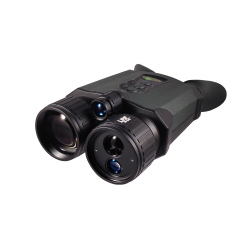


The Luna Optics LN-QD-B50-PRO Quantum Digital 2K night vision binocular features a 2560 × 1440 CMOS sensor, 6x optical magnification, and an integrated laser rangefinder rated to 1,500 meters (1,635 yards). Record QHD video, capture 16.1MP photos, and observe after dark with built-in 850nm infrared illumination.
Want enhanced low-light specifications and dual-wavelength IR? Explore the LN-QE-B50 Quantum Elite. For the standard model, see the LN-QD-B50.

When will this item ship?
| Technical Specifications | |
|---|---|
| Model | LN-QD-B50-PRO |
| Product Type | Digital day/night vision binoculars with recording |
| Sensor Type | CMOS, Quantum Digital QHD sensor |
| Sensor Resolution | 2560 × 1440 pixels |
| Sensor Light Sensitivity | 0.0015 lux |
| Displays | Dual 0.39-inch AMOLED, 1024 × 768 pixels each |
| Image Color Modes | Daytime Color, Nighttime Color, Black & White, NV Green Phosphor, NV White Phosphor, Amber |
| Still Image Resolution | 5360 × 3008 pixels, 16.1 MP |
| Video Recording | FHD at 60 fps; QHD and HD at 30 fps |
| Image Stabilization | Electronic stabilization at 6x optical magnification |
| Wi-Fi | Yes; compatible with iOS and Android |
| Magnification | 6x optical, up to 36x with digital magnification |
| Objective Lens | 50mm, f/1.0 |
| Field of View | 10 degrees at 6x optical magnification |
| Minimum Focusing Distance | 80cm (2.6 ft) |
| Laser Rangefinder Maximum Range | 1,500m (1,635 yards) |
| Laser Rangefinder Wavelength | 905nm, Class 1 eye-safe laser |
| Advertised Nighttime Visibility Range | Up to 600m (654 yards) |
| Integrated IR Illuminator | 850nm, 1W, Class 3R |
| Automatic Daylight/IR Filter | Internal automatic IR and daylight color-enhancing filter |
| Memory Card | MicroSD, up to 512GB |
| Battery Type | Four 3V CR123A or CR123R batteries |
| External Power | 5V/2A power bank via USB-C |
| Advertised Battery Runtime | Up to 4.5 hours with IR off at 20°C using CR123A batteries |
| Video Output | Micro-HDMI, 1080p output |
| Operating Temperature | -22°F to 122°F (-30°C to 50°C) |
| Dimensions | 190 × 126 × 76mm (7.5 × 4.9 × 2.9 inches) |
| Weight | 800g (1.76 lbs) |
| Warranty | 2 years |
| Included Accessories | Deluxe carry case, padded neck strap, 32GB microSD card, USB-C cable, HDMI cable, microSD-to-USB adapter, cleaning cloth |
The LN-QD-B50-PRO uses Luna Optics' Quantum Digital QHD CMOS sensor with a native resolution of 2560 × 1440 pixels and a published light-sensitivity rating of 0.0015 lux. The sensor captures the image that is processed and shown on the binoculars' internal displays or saved as a photo or video.
The sensor is designed for both daytime and nighttime use. In low-light conditions, its sensitivity helps it make use of available light. When the scene becomes too dark for effective viewing without additional illumination, the integrated infrared illuminator can supply light the sensor can detect.
Resolution and sensitivity describe different aspects of performance. Resolution affects how much spatial detail the sensor can capture, while sensitivity influences its ability to work with limited light. Learn more in our guide to night vision CMOS sensors, resolution, and sensitivity.
The defining feature of the LN-QD-B50-PRO is its integrated laser rangefinder, rated to measure distances up to 1,500 meters (1,635 yards). It provides a distance reading to help determine how far away a target is, rather than relying solely on visual estimation.
The rangefinder uses a 905nm Class 1 eye-safe laser. Luna Optics specifies a measurement range of approximately 10 to 1,500 meters for buildings in the instruction manual. Actual results depend on the target's size and reflectivity, environmental conditions, and other factors.
The 1,500-meter rating is particularly useful when observing across large open areas where knowing the distance to a structure or other suitable target helps put the view into context. It is important to distinguish the rangefinder's measuring capability from the binoculars' advertised nighttime visibility range of up to 600 meters. Obtaining a distance reading does not guarantee that a target can be clearly identified at that distance.
The standard LN-QD-B50 has a rangefinder rated up to 1,000 meters, while the PRO extends that published maximum to 1,500 meters. For a detailed explanation of the differences between the lineup, read Luna Optics LN-QD-B50 vs. LN-QD-B50-PRO vs. LN-QE-B50.
The LN-QD-B50-PRO provides 6x optical magnification, with digital magnification up to 36x. Optical magnification is provided by the lens system. Digital magnification enlarges the captured image to make a subject appear closer on the display.
Electronic image stabilization is available at the 6x optical setting to help reduce the effects of small hand movements when observing a subject. At higher digital magnification, movement becomes more noticeable, and image softness or noise can become easier to see.
For distant wildlife or other stationary subjects, digital magnification can help you inspect a portion of the image without physically moving closer. For moving subjects, the narrower apparent field of view at high magnification can make tracking more difficult.
Understand the difference between optical and digital magnification in our guide to digital zoom vs. optical zoom in night vision.
The LN-QD-B50-PRO includes a built-in 850nm, 1W infrared illuminator. It supplies additional near-infrared light when ambient light is insufficient for useful viewing. The sensor detects light reflected from objects in the scene and uses it to form the displayed image.
850nm is a commonly used wavelength for digital night vision because many sensors respond well to it. Depending on the emitter design and viewing conditions, a faint red glow may be visible at the illuminator itself, even though the infrared beam is not normally visible to the unaided eye.
Luna Optics advertises nighttime visibility of up to 600 meters (654 yards) for the LN-QD-B50-PRO. Actual visibility depends on the target, available light, atmospheric conditions, focus, and use of the illuminator. Detecting an object at a distance does not necessarily mean there is enough detail to identify it.
For more information about infrared wavelength and illumination choices, read Understanding Infrared Illuminators: 850nm vs. 940nm vs. Laser IR.
The LN-QD-B50-PRO records video at up to 2560 × 1440 pixels in QHD at 30 frames per second. It also supports Full HD recording at 60 frames per second and HD recording at 30 frames per second. Still photographs are saved at 5360 × 3008 pixels, advertised as 16.1 megapixels.
QHD recording captures more pixels per frame than Full HD, making it useful when preserving fine detail in recorded observations is a priority. Full HD at 60 frames per second provides a higher frame rate, which can produce smoother-looking footage of moving subjects.
The listed 16.1MP still-photo resolution describes the saved image dimensions, not the native sensor resolution. The detail preserved in a photo or video also depends on lighting, focus, sensor performance, and image processing.
The binoculars use dual 0.39-inch AMOLED displays, each with a resolution of 1024 × 768 pixels. Available image modes include daytime color, nighttime color, black and white, NV green phosphor, NV white phosphor, and amber.
These modes allow you to select a presentation that suits the scene and your viewing preferences. Monochrome modes can make contrast easier to interpret in some nighttime conditions, while color modes are useful for daytime observation and suitable low-light scenes.
The displays are specified for operation in temperatures as low as -22°F (-30°C). This makes the LN-QD-B50-PRO suitable for a range of cold-weather applications within its stated operating limits.
The LN-QD-B50-PRO includes an internal automatic daylight color-enhancing filter that also functions as an infrared filter. During daylight, the filter helps maintain natural-looking color by blocking infrared light that could affect the image. When the infrared illuminator is activated for nighttime viewing, the filter automatically disengages so the sensor can use the infrared illumination.
This automatic operation supports daytime and nighttime use without requiring the user to manually change an external filter. For more background, read Why Does Digital Night Vision Work During the Day?
The LN-QD-B50-PRO supports Wi-Fi connectivity with compatible iOS and Android devices, allowing you to stream the image to a compatible mobile device. Photos and videos can be stored on a microSD card with a supported capacity of up to 512GB.
The binoculars use four CR123A or CR123R batteries and are rated for up to 4.5 hours of operation with the IR illuminator off under the manufacturer's stated test conditions. Actual runtime varies with temperature, display settings, recording, infrared use, and battery condition.
For longer observation sessions, the device can also operate from a compatible 5V/2A external power bank connected through USB-C. The micro-HDMI output supports 1080p video output to a compatible external display.
The LN-QD-B50-PRO shares its Quantum Digital sensor, 850nm infrared illuminator, 6x optical magnification, and QHD recording capability with the standard LN-QD-B50. Its main specification advantage over the standard model is the rangefinder rated up to 1,500 meters rather than 1,000 meters.
The LN-QE-B50 Quantum Elite moves to a higher-resolution sensor with a lower published lux sensitivity rating, adds dual 850nm and 940nm infrared illumination, and has a higher advertised nighttime visibility range. It also features a different battery system and longer stated runtime.
Choose the LN-QD-B50-PRO when its 1,500-meter rangefinder rating is a priority and the Quantum Digital imaging specifications meet your needs. If enhanced low-light specifications and infrared wavelength flexibility are more important, consider the LN-QE-B50.
Read the full Luna Optics LN-QD-B50 vs. LN-QD-B50-PRO vs. LN-QE-B50 comparison for a detailed technical breakdown.

Specific References
The Luna Optics LN-QD-B50-PRO Quantum Digital 2K night vision binocular features a 2560 × 1440 CMOS sensor, 6x optical magnification, and an integrated laser rangefinder rated to 1,500 meters (1,635 yards). Record QHD video, capture 16.1MP photos, and observe after dark with built-in 850nm infrared illumination.
Want enhanced low-light specifications and dual-wavelength IR? Explore the LN-QE-B50 Quantum Elite. For the standard model, see the LN-QD-B50.