
Luna Optics LN-QD-B50 vs. LN-QD-B50-PRO vs. LN-QE-B50: Technical Differences Explained
The Luna Optics LN-QD-B50, LN-QD-B50-PRO, and LN-QE-B50 Quantum Elite are digital day and night vision binoculars built around 6x optical magnification, a 50mm objective lens, electronic image stabilization, onboard recording, and dual AMOLED displays. The main differences are their image sensors, low-light sensitivity, infrared illumination, laser rangefinders, video capabilities, and power systems.
Those specifications affect more than the numbers on a product sheet. Sensor performance influences how much detail you can see in low light. Infrared illumination affects how effectively you can observe in darkness. A laser rangefinder provides a measured distance to a target, while the battery system determines how long you can stay in the field before changing or recharging batteries.
This guide explains the technical differences between the LN-QD-B50, LN-QD-B50-PRO, and LN-QE-B50, with an emphasis on how each difference translates to real-world observation.
At a Glance: Technical Specifications
| Feature | LN-QD-B50 | LN-QD-B50-PRO | LN-QE-B50 |
|---|---|---|---|
| Sensor | Quantum Digital QHD CMOS | Quantum Digital QHD CMOS | Quantum Elite UHD CMOS |
| Sensor resolution | 2560 × 1440 | 2560 × 1440 | 2880 × 2160 |
| Rated sensor sensitivity | 0.0015 lux | 0.0015 lux | 0.0005 lux |
| Maximum advertised video resolution | Up to 2560 × 1440 | Up to 2560 × 1440 | Up to 2880 × 2160, marketed as 4K |
| Laser rangefinder | Up to 1,000 m | Up to 1,500 m | Up to 1,500 m |
| Advertised nighttime visibility range | Up to 600 m | Up to 600 m | Up to 1,000 m |
| Infrared illuminator | 850nm | 850nm | Dual 850nm and 940nm |
| Objective lens | 50mm, f/1.0 | 50mm, f/1.0 | 50mm, f/0.9 |
| Magnification | 6x optical, up to 36x total | 6x optical, up to 36x total | 6x optical, up to 36x total |
| Electronic image stabilization | Yes, at 6x optical | Yes, at 6x optical | Yes, at 6x optical |
| Internal displays | Dual 1024 × 768 AMOLED | Dual 1024 × 768 AMOLED | Dual 1024 × 768 AMOLED |
| Still photographs | 16.1 MP advertised output | 16.1 MP advertised output | 16.1 MP advertised output |
| Battery system | Four CR123A batteries | Four CR123A batteries | Two or four rechargeable 18650 batteries |
| Advertised battery runtime | Up to 4.5 hours with IR off | Up to 4.5 hours with IR off | Up to 8.5 hours with IR off |
| Maximum microSD capacity | 512GB | 512GB | 512GB |
Specifications are based on published manufacturer information and current product listings. Runtime and visibility figures depend on operating conditions. Luna Optics markets the QE-B50 as a 4K model; its published sensor and video dimensions are 2880 × 2160 pixels, so buyers who need a specific recording format should verify the actual output dimensions.
 1. Quantum Digital vs. Quantum Elite Sensors
The LN-QD-B50 and LN-QD-B50-PRO use Luna Optics' Quantum Digital QHD CMOS sensor. The LN-QE-B50 uses the newer Quantum Elite UHD CMOS sensor. This is the most important distinction between the two QD models and the QE-B50 because the sensor affects the image captured before magnification, display processing, or recording.
The QD sensor resolution is 2560 × 1440 pixels, while the QE sensor resolution is 2880 × 2160 pixels. The QE sensor therefore has a higher native pixel count, particularly in the vertical dimension. This gives it more image samples to work with when capturing fine details.
What does that mean in the field? When observing an animal across a field or trying to distinguish details on a distant object, a higher-resolution sensor can preserve more detail when the lens delivers a sufficiently sharp image and the lighting supports it. That extra information can also benefit recorded footage.
However, the sensor's low-light sensitivity is an equally important part of the upgrade. The QE-B50 is rated at 0.0005 lux, compared with 0.0015 lux for the QD models. The lower rated figure indicates a greater stated ability to operate under very low illumination, according to the manufacturer's specifications.
For someone watching wildlife after sunset, this combination of higher sensor resolution and greater rated sensitivity is the QE-B50's main technical advantage. It is designed to capture more image information while working with less available light. The actual visible improvement will depend on ambient light, the subject, focus, infrared illumination, and viewing conditions.
2. Sensor Resolution: 2560 × 1440 vs. 2880 × 2160
Resolution describes the number of pixels used to capture an image. The QD models' 2560 × 1440 sensors contain approximately 3.69 million pixels. The QE-B50's 2880 × 2160 sensor contains approximately 6.22 million pixels, about 69% more pixels than the QD sensor.
This does not mean the QE-B50 will always show 69% more visible detail. Resolution is only useful when the optical system, lighting, focus, and processing preserve the additional information. But the difference in native pixel count is substantial.
Real-world effect: Higher native resolution can help retain fine features in a captured image, particularly when the subject is well lit and sharply focused. It can also give recorded images more detail to work with during playback or cropping.
For example, when viewing a stationary animal at a distance, extra sensor resolution may help preserve the outline of its body or smaller features in a recording. In very dark conditions, however, limited light and image noise may reduce the visible benefit of those additional pixels. A higher pixel count does not compensate for a scene that provides too little usable signal.
It is also important to distinguish sensor resolution from saved photo resolution. All three models advertise 16.1-megapixel still images, but their native sensor resolutions differ. The saved image dimensions therefore should not be treated as a direct measurement of native sensor detail.
 3. Low-Light Sensitivity: 0.0015 Lux vs. 0.0005 Lux
Lux is a measurement of illuminance: the amount of visible light falling on a surface. Luna Optics publishes a sensitivity rating of 0.0015 lux for both QD models and 0.0005 lux for the QE-B50.
The QE-B50's rated figure is one-third the lux value of the QD models. That is a meaningful difference in the published specifications, although the figures alone do not provide a complete, independently measured comparison of image quality under identical conditions.
Why does sensitivity matter? At night, the sensor may receive very few photons from a subject. A sensor designed to work at lower light levels can make better use of the available signal, helping the device produce a usable image when the scene is dim.
In practical terms, the QE-B50 is the model to consider if you frequently observe in deep twilight, under heavy tree cover, or in other conditions where little ambient light reaches the subject. Its more sensitive sensor is intended to improve nighttime observation without relying as heavily on additional IR illumination.
This does not mean that the QE-B50 never needs an illuminator. Under sufficiently dark conditions, even a sensitive digital sensor may benefit from infrared light. The advantage is the ability to work with less available light, not the elimination of every need for illumination.
4. Video Recording: QHD vs. the QE-B50's Higher-Resolution Mode
The QD-B50 and QD-B50-PRO record video at up to 2560 × 1440 pixels, which Luna Optics describes as True 2K. The QE-B50 is marketed as a 4K model and lists video capture up to 2880 × 2160 pixels.
Higher recording resolution can preserve more spatial information in footage, provided the sensor captures that detail and the device records it without excessive processing or compression. It is particularly useful when reviewing a recording on a larger screen or examining a still frame from the video.
Real-world effect: If you regularly record wildlife activity, observe animals at a distance, or document what you see during nighttime observation, the QE-B50's higher-resolution recording mode offers more image data than the QD models' listed maximum of 2560 × 1440.
There is one technical detail worth understanding: conventional UHD 4K video is typically 3840 × 2160 pixels. Luna Optics markets the QE-B50 as 4K, while its published video dimensions are 2880 × 2160. If you specifically require standard 3840 × 2160 output for a video workflow, confirm the exact recording format before purchasing.
The QD models still offer high-resolution video recording. For casual documentation, sharing footage, and reviewing observations, their QHD recording capability may be entirely adequate.
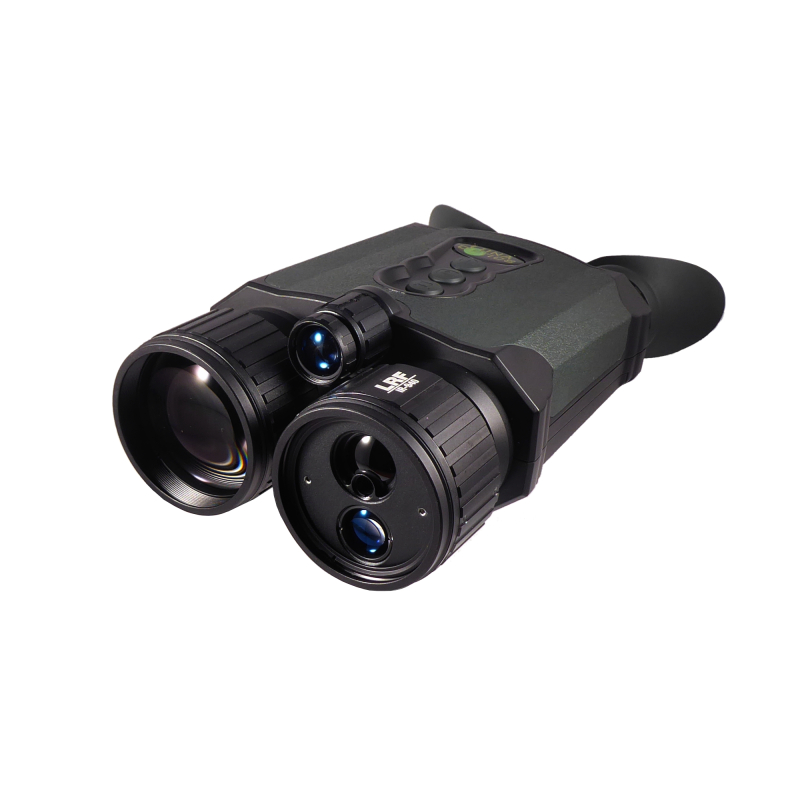 5. Laser Rangefinder: 1,000 Meters vs. 1,500 Meters
The laser rangefinder is a major difference between the standard QD-B50 and the two higher-tier models. The QD-B50 is specified with a maximum rangefinding distance of 1,000 meters, while the QD-B50-PRO and QE-B50 are rated up to 1,500 meters.
A rangefinder measures the distance to a target by sending a laser pulse and calculating the return time. It provides a distance measurement rather than estimating distance from how large the target appears in the image.
What does the extra range mean? The 1,500-meter rating gives the PRO and QE models a greater stated rangefinding capability when measuring distant objects. This can be useful for land management, wildlife surveys, and observation across large open areas where knowing the distance helps interpret what you are viewing.
Rangefinding distance and night vision visibility distance are different specifications. A rangefinder may measure a target farther away than the binoculars can provide a useful level of visual detail. The ability to obtain a distance reading does not mean the target can be clearly identified at that distance.
The standard QD-B50 already has an integrated rangefinder, so the PRO model's advantage is its longer rated measurement range—not the addition of rangefinding itself.
6. Advertised Nighttime Visibility: 600 Meters vs. 1,000 Meters
Luna Optics lists a nighttime visibility range of up to 600 meters for both QD models and up to 1,000 meters for the QE-B50. These are manufacturer-rated figures, and actual viewing performance depends on the target, the amount of ambient light, infrared illumination, atmospheric conditions, and what level of detail the observer needs.
The QE-B50's higher sensitivity rating, higher-resolution sensor, and f/0.9 objective lens contribute to its higher advertised nighttime visibility range. The QD models use the same Quantum Digital sensor and f/1.0 lens, with a lower published visibility rating.
Real-world effect: If you observe across large fields, open woodland edges, or other areas where subjects may be hundreds of meters away, the QE-B50's higher rated visibility range is an important advantage to consider. It is designed to extend useful nighttime observation farther than the QD models.
Distance alone does not describe how clearly a subject can be seen. At a given range, you may be able to detect movement or recognize the shape of an animal without seeing enough detail for confident identification. Subject size, contrast, weather, focus, and illumination all influence the result.
For a fuller explanation of these differences, read How Far Can Night Vision See at Night?
7. Infrared Illumination: 850nm vs. Dual 850nm and 940nm
The LN-QD-B50 and LN-QD-B50-PRO use an integrated 850nm infrared illuminator. The LN-QE-B50 adds a dual-wavelength system with 850nm and 940nm infrared illumination.
Infrared illumination provides light that a compatible digital sensor can detect even when the scene is too dark for ordinary viewing. The sensor uses the reflected infrared light to form an image, making the illuminator especially useful in very dark conditions.
The 850nm wavelength is commonly used in digital night vision because many sensors respond well to it. A faint red glow may be visible at the illuminator itself, depending on the design and viewing conditions.
At 940nm, the emitter generally produces less visible red glow, but some sensors are less sensitive to this wavelength. The practical result depends on the sensor and illuminator design.
Why does dual IR matter? Having both wavelengths gives the QE-B50 more flexibility in selecting infrared illumination for the situation. The 850nm option can be useful when illumination performance is the priority, while 940nm may be preferable when reducing visible emitter glow matters more.
Neither wavelength guarantees a particular viewing distance. The illuminator's output and beam, the sensor's response, and the subject's distance and reflectivity affect the result. The key benefit of the QE-B50 is having two infrared wavelength options rather than being limited to 850nm.
8. Objective Lens: f/1.0 vs. f/0.9
All three models use a 50mm objective lens. The QD-B50 and QD-B50-PRO have an f/1.0 lens, while the QE-B50 has a faster f/0.9 lens.
The f-number describes the aperture relative to the lens's focal length. A lower f-number generally allows more light to reach the sensor, assuming other factors such as lens transmission are comparable.
Real-world effect: The QE-B50's f/0.9 lens is designed to pass more light than an f/1.0 lens. That is helpful for a digital night vision system because the sensor needs as much useful light as the optical system can deliver when viewing in darkness.
The difference between f/1.0 and f/0.9 is relatively modest by itself. The QE-B50's more sensitive sensor and higher resolution are also important parts of its nighttime performance advantage. The lens aperture should be understood as one component of the overall system, not the sole reason for the longer advertised visibility range.
9. Magnification: 6x Optical and Up to 36x Digital
All three binoculars offer 6x optical magnification with digital magnification up to 36x. This means the lens provides the base optical view, while higher magnification levels use digital processing to enlarge the captured image.
Optical magnification changes how large the subject appears through the optics. Digital magnification enlarges a portion of the sensor image, making the subject fill more of the display but not capturing additional native detail.
Real-world effect: At 6x optical magnification, the image generally retains the strongest basis for fine detail, and electronic image stabilization is available at this setting. As you increase digital magnification, small features may become easier to inspect on the display, but pixel structure, noise, and softness can become more noticeable.
For stationary subjects, digital zoom can be helpful when you want a closer look without physically moving nearer. For moving wildlife, high digital magnification can make it harder to keep the subject in view because the field of view becomes narrower.
Because all three models share the same stated 6x optical and 36x maximum magnification range, the QE-B50's higher sensor resolution and sensitivity are the more important differences when considering image detail at high digital magnification.
Learn more in Digital Zoom vs. Optical Zoom in Night Vision: Technical Differences and Real-World Performance.
10. Electronic Image Stabilization
All three models include electronic image stabilization, which Luna Optics specifies as available at 6x optical magnification. Stabilization helps compensate for small hand movements that can make the displayed image appear to shake.
At higher magnification, even slight movement becomes more noticeable. Stabilization is therefore particularly useful when observing distant stationary subjects while holding the binoculars by hand.
Real-world effect: At the native 6x optical setting, stabilization can make it easier to maintain a steady view and observe a subject without as much visible hand-induced movement. Since the published specification limits stabilization to 6x optical magnification, do not assume it will provide the same benefit when using the full 36x digital magnification.
This is a shared feature, so it is not a reason on its own to choose one model over another.
11. Internal AMOLED Displays
All three models use dual 1024 × 768 AMOLED displays measuring 0.39 inches. These screens present the processed image to the user's eyes through the binocular eyepieces.
AMOLED displays can deliver strong contrast and vivid image presentation. Luna Optics also specifies that the displays in these models are designed to operate in temperatures as low as -22°F (-30°C).
Real-world effect: The display is the final stage between the captured image and what you see. A good display helps present contrast and tonal differences clearly, but it cannot restore details that were lost because of insufficient light, poor focus, or sensor limitations.
Since the listed display resolution is the same across all three models, the QE-B50's advantage comes from its higher-resolution sensor and other imaging components, rather than a higher-pixel-count internal display.
12. Still Photographs: Advertised 16.1 Megapixels
All three models advertise 16.1-megapixel still photographs at 5360 × 3008 pixels. This is the output resolution of the saved photographs, not the native resolution of the CMOS sensor.
Real-world effect: The saved image dimensions determine the size of the photo file and provide flexibility for viewing, sharing, and cropping. However, the detail in the file still depends on what the sensor and optical system captured.
Because the QE-B50 uses a higher-resolution native sensor, its captured image can contain more native sensor information even though the listed still-photo output resolution is the same. The final difference in visible detail will depend on processing and the conditions in which the photograph was taken.
13. Battery System and Operating Time
The QD-B50 and QD-B50-PRO use four CR123A batteries, with published runtime of up to 4.5 hours with the infrared illuminator off. The QE-B50 uses two or four rechargeable 18650 batteries and is rated for up to 8.5 hours with IR off.
These runtime figures are not guarantees for every situation. Infrared illumination, display brightness, recording, Wi-Fi use, temperature, and battery condition can all affect operating time.
Real-world effect: The QE-B50's longer advertised runtime is useful for extended observation sessions when returning to replace batteries is inconvenient. Its rechargeable 18650 system also provides a different approach to power management than the CR123A system used by the QD models.
The QD models' CR123A batteries are widely used in other electronic equipment, and the devices can also be powered from a compatible external 5V/2A power source through USB-C. The QE-B50 likewise supports external USB-C power.
For longer outings, it is worth planning around the manufacturer's runtime conditions and carrying suitable spare batteries or an appropriate external power source.
14. Recording, Wi-Fi, and Storage
All three binoculars support onboard photo and video recording, Wi-Fi connectivity to compatible iOS and Android devices, and microSD cards up to 512GB. They also include USB-C external power and HDMI video output.
Real-world effect: These shared features allow you to save observations for later review, transfer or stream images to a compatible device, and retain footage without needing a separate camera. A larger supported memory card can be useful when recording many clips or longer observation sessions.
The primary difference in recording capability is the maximum listed video resolution: the QD models record up to 2560 × 1440, while the QE-B50 is marketed for higher-resolution recording up to 2880 × 2160. The core storage and connectivity features are otherwise similar.
Which Luna Optics Binocular Is Right for You?
Choose the LN-QD-B50 for capable digital night vision with rangefinding
The LN-QD-B50 uses the Quantum Digital sensor, 6x optical magnification, an 850nm illuminator, and a rangefinder rated up to 1,000 meters. It records QHD video and provides the core day/night viewing and recording features found across the three models.
It is a practical option for users who want digital night vision for wildlife observation, property viewing, and outdoor use without needing the QE-B50's higher-rated low-light sensitivity and dual-wavelength IR system.
Choose the LN-QD-B50-PRO for a longer-range laser rangefinder
The LN-QD-B50-PRO shares the same Quantum Digital sensor, sensitivity rating, lens aperture, infrared wavelength, and maximum advertised nighttime visibility range as the standard QD-B50. Its principal specification advantage is a laser rangefinder rated up to 1,500 meters rather than 1,000 meters.
Choose the PRO when that additional rangefinding capability is important for measuring distances across large properties or open terrain. It does not offer a higher-resolution sensor or the QE-B50's dual IR system.
Choose the LN-QE-B50 for the strongest published nighttime imaging specifications
The LN-QE-B50 is the flagship of these three models. Its Quantum Elite sensor has a higher native resolution and a lower published lux sensitivity rating. It also has an f/0.9 lens, dual 850nm and 940nm infrared illumination, a 1,500-meter rangefinder, a higher listed video resolution, and an advertised nighttime visibility range of up to 1,000 meters.
These upgrades make the QE-B50 the strongest fit for users who prioritize nighttime image performance, flexibility in infrared illumination, and extended observation sessions. Its rechargeable 18650 battery system and longer stated runtime are additional advantages for prolonged use.
Frequently Asked Questions
Do the LN-QD-B50 and LN-QD-B50-PRO have the same sensor?
Yes. Both use the Quantum Digital QHD CMOS sensor with a published resolution of 2560 × 1440 pixels and a rated sensitivity of 0.0015 lux. The PRO's main difference is its rangefinder, rated up to 1,500 meters compared with 1,000 meters for the standard QD-B50.
Does the LN-QE-B50 have better low-light sensitivity?
It has a lower published sensor sensitivity figure: 0.0005 lux compared with 0.0015 lux for the QD models. Luna Optics positions the Quantum Elite sensor as an improvement for very low-light observation. Actual image performance depends on the scene and operating conditions.
Does the standard LN-QD-B50 include a laser rangefinder?
Yes. The current product listing specifies an integrated laser rangefinder rated up to 1,000 meters. The QD-B50-PRO and QE-B50 are rated up to 1,500 meters.
Can all three models record video and take photos?
Yes. All three support onboard photo and video recording, Wi-Fi connectivity, and microSD storage up to 512GB. Their main recording difference is the maximum listed video resolution.
Do all three models have optical zoom up to 36x?
No. All three provide 6x optical magnification and use digital magnification to reach up to 36x. Digital magnification enlarges the captured image rather than providing additional optical magnification.
Final Verdict
The most important difference between the three Luna Optics binoculars is the distinction between the Quantum Digital models and the Quantum Elite model. The QD-B50 and QD-B50-PRO share the same sensor and core imaging specifications; the PRO's key advantage is its longer-range laser rangefinder. The QE-B50 combines a higher-resolution sensor, a lower rated lux sensitivity figure, a faster lens, dual-wavelength IR illumination, longer advertised nighttime visibility, and a longer stated battery runtime.
For users choosing between the two QD models, the deciding factor is whether the PRO's 1,500-meter rangefinder rating is worth the additional cost. For users who place a higher priority on low-light imaging and illumination flexibility, the QE-B50 provides the most substantial technical upgrade.