
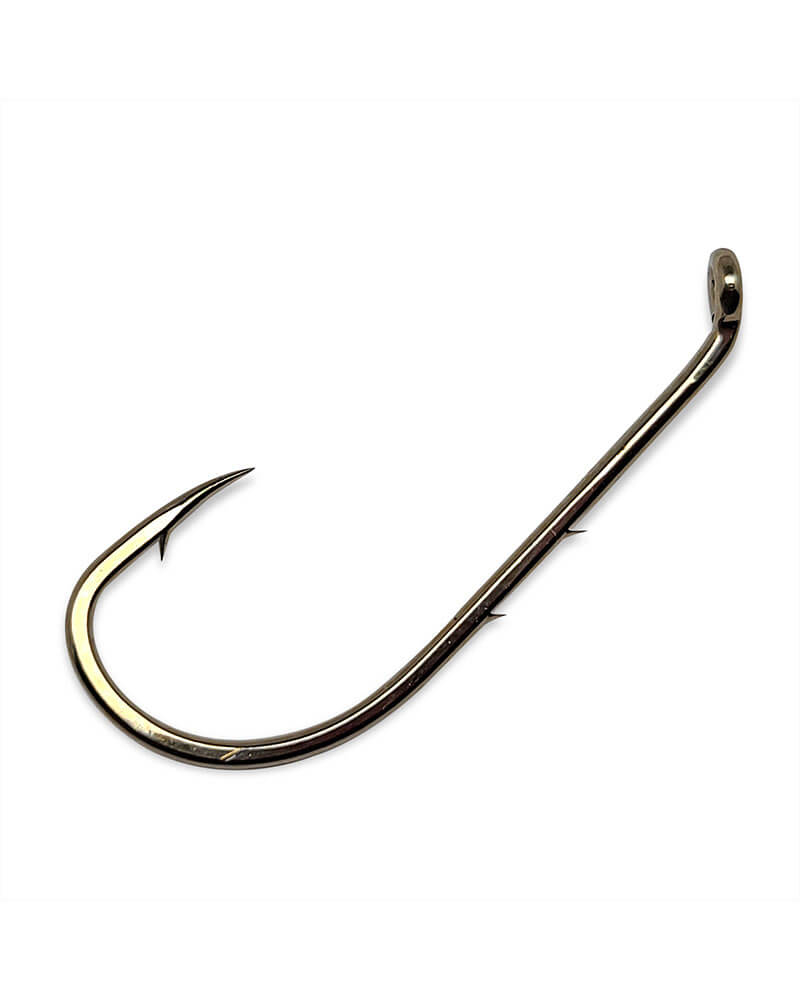
 Baitholder hooks are designed to keep soft natural bait securely on the hook. They look similar to traditional J-hooks, but they have one or more small barbs or slices cut into the shank. These barbs grip worms, nightcrawlers, dough baits, cut bait, and other soft baits so they are less likely to slide down the shank or come off during a cast.
The design is simple, but it solves one of the most common problems with bait fishing: keeping the bait where it needs to be on the hook. Baitholder hooks are especially common for freshwater bait fishing, including trout, panfish, perch, walleye, and catfish, as well as some saltwater applications involving worms, shrimp, squid, and pieces of baitfish.
Baitholder hooks are not intended for every type of fishing. Their primary advantage is bait retention, and their design is most useful when fishing soft natural bait that tends to slide, tear, or fall off a conventional hook.
What Is a Baitholder Hook?
A baitholder hook is a bait-fishing hook with additional barbs on the shank. Most baitholder hooks have a conventional J-hook shape, although the exact bend, point, eye, shank length, and wire diameter vary by model.
The defining feature of a baitholder hook is the bait-holding barb or barbs on the shank. When a worm or other soft bait is threaded onto the hook, these barbs catch the bait and help prevent it from sliding toward the bend or off the hook.
Some designs have two barbs while others use different shank configurations. Certain baitholder hooks also have longer shanks, beaked or reversed points, and turned-down eyes that make them suitable for snelling. Manufacturer designs demonstrate how much these details can vary between individual baitholder patterns.
The important distinction is that a baitholder hook is designed primarily to secure the bait. The barbs are not intended to function like the hook point. They hold the bait in position so the main point remains available to hook the fish.
How Do Baitholder Hooks Work?
To use a baitholder hook, the bait is threaded onto the hook shank and over the small barbs. As the bait is pushed up the shank, the barbs grip the material and resist movement.
This is particularly useful with worms and other soft baits that tend to slide toward the bend when the rig is cast. Without a bait keeper, a soft worm can bunch up or move out of position after only a few casts.
The barbs also help when small fish repeatedly pick at the bait. Instead of allowing every bite to pull the bait farther down the shank, the barbs help keep the remaining bait secured.
The hook point should remain exposed enough to penetrate the fish's mouth. Packing too much bait onto the hook can defeat the purpose of the design by covering the point and reducing the available gap.
What Baits Are Baitholder Hooks Used For?
Baitholder hooks are primarily used with soft natural baits that need help staying on the hook:
- Nightcrawlers
- Red worms
- Worm pieces
- Prepared dough baits
- Soft processed baits
- Pieces of baitfish
- Chicken liver and other soft catfish baits
- Shrimp
- Squid pieces
- Other soft natural baits
They are particularly effective when the bait is threaded onto the hook rather than simply hooked once through a firm portion of the bait. Manufacturers specifically market baitholder patterns for worms, ragworms, crabs, fish chunks, shrimp, squid, and similar baits.
Advantages of Baitholder Hooks
They Keep Soft Bait on the Hook
The primary advantage of a baitholder hook is straightforward: the shank barbs hold bait in place. This is very important when casting. A worm threaded onto an ordinary hook can slide down the shank as the rig accelerates during the cast. The bait may bunch near the bend, tear, or come off entirely. We've all had this happen, and it's always frustrating.
Baitholder barbs prevent this, allowing the bait to remain positioned on the shank.
They Reduce Bait Loss
Natural bait can be expensive or time-consuming to prepare, and losing bait after every cast quickly becomes frustrating. A baitholder hook can keep a piece of bait usable through multiple casts or bites that might otherwise strip it from a plain hook. This is particularly valuable when fishing from shore, where long casts are often necessary to reach productive water, and the force required to cast long distances causes the bait to slide towards the bend of the hook.
They Work Well With Worms
Worms and nightcrawlers are among the most common applications for baitholder hooks. The long, soft shape of a worm makes it particularly prone to sliding down a conventional hook. Threading the worm over the baitholder section allows the barbs to grip the worm while leaving enough of the bait and hook exposed to present it effectively.
They Are Versatile Bait Hooks
A baitholder hook can be used for much more than one species or bait. Depending on size and construction, the same basic hook design can be used for panfish, trout, perch, walleye, bass, catfish, and various saltwater species. This makes baitholder hooks a practical choice when one tackle setup needs to accommodate several types of natural bait.
They Are Simple to Rig
Baitholder hooks do not require a complicated rig. The bait is simply threaded onto the hook and positioned over the shank barbs. That simplicity is one reason they remain popular for general-purpose bait fishing. They are effective without requiring specialized rigging techniques.
Disadvantages of Baitholder Hooks
The Barbs Can Make Unhooking More Difficult
The same barbs that keep bait on the hook can make the hook more difficult to remove if a fish swallows it deeply. Removing a hook that is lodged deep in the mouth or throat can cause additional tissue damage, particularly when the hook must be manipulated to work the shank barbs back through tissue.
This is one reason baitholder hooks are not necessarily the first choice when the primary concern is minimizing deep hooking. In situations where natural bait is being fished for catch-and-release, a properly selected circle hook may be more appropriate, because its design is intended to promote hooking near the corner of the mouth.
They Are Not Ideal for Delicate Live Bait
The barbs and relatively substantial shank used on many baitholder hooks can damage delicate live bait or restrict its movement. A live minnow, for example, often benefits from a hook that allows it to move naturally. In this scenario, a live minnow can be further injured by the barbs on a baitholder hook, causing it to die on the hook prematurely. A compact octopus hook or another live-bait design may be better suited to that application than a traditional baitholder.
Baitholder hooks are generally better suited to worms, pieces of bait, and other natural baits that benefit from being firmly secured to the hook.
Too Much Bait Can Reduce Hooking Efficiency
A common mistake is adding more bait simply because the hook has barbs designed to hold it. If the hook point becomes buried under a thick mass of bait, there may not be enough exposed point and gap to catch the fish effectively. The bait should cover the appropriate portion of the shank while leaving the hook point available.
They Are Not a Universal Substitute for Other Hook Styles
Baitholder hooks are excellent at one particular job: securing natural bait. Other hook styles are better suited to specialized applications.
Circle hooks are designed around a different hooking mechanism and are widely used when fishing bait while reducing deep hooking is important. Octopus hooks have a compact profile that works well with minnows, leeches, and other small natural baits. Aberdeen hooks use a lighter wire and are commonly used for small bait and panfish applications.
Choosing a baitholder simply because it is available can result in a less effective presentation when another hook style better matches the bait or technique.
When Are Baitholder Hooks Commonly Used?
Trout Fishing
Baitholder hooks are commonly used when trout are targeted with worms, prepared bait, and other natural offerings.
The bait-retention barbs are particularly useful when fishing from shore or casting a baited rig toward deeper water. Smaller baitholder hooks are commonly used for trout and other small fish.
Panfish
Bluegill, sunfish, perch, and other panfish are frequently targeted with worms, pieces of nightcrawler, insects, and prepared bait. Small baitholder hooks provide an easy way to keep these baits on the hook.
Hook size should be matched to both the bait and the fish. A small piece of worm intended for bluegill may require a much smaller hook than a whole nightcrawler intended for larger fish.
Walleye
Baitholder hooks can be useful for walleye when fishing worms and other natural baits, particularly in situations where the bait needs to remain securely positioned during repeated casts.
However, walleye anglers also commonly use other hook styles, including octopus and circle hooks, depending on the bait and rig. The best choice depends on how the bait is presented and how the fish are expected to take it.
Catfishing
Larger baitholder hooks can be used with pieces of baitfish, worms, prepared baits, and other natural offerings for catfish.
The shank barbs are particularly useful for soft baits that can slide down the hook during casting or after repeated bites. Larger hook sizes and heavier-wire patterns may be appropriate when targeting larger fish.
General Bank Fishing
Baitholder hooks are particularly practical for basic bank-fishing rigs because they work with inexpensive and readily available natural baits.
A simple hook-and-sinker or float rig can be used with worms, corn, dough, bait pieces, or other soft baits. The baitholder design helps the bait survive the cast and remain properly positioned while it is being fished.
How to Rig a Baitholder Hook
The exact rigging method depends on the bait, but the basic process is straightforward.
- Choose a hook size appropriate for the bait and target fish.
- Insert the hook point into the bait.
- Thread enough bait onto the shank to cover the bait-holder barbs.
- Work the bait over the barbs so they grip the bait securely.
- Position the remaining bait naturally around the hook.
- Make sure the hook point remains sufficiently exposed.
With a nightcrawler, for example, the worm can be threaded over the point and along the shank. The barbs grip the worm and keep it from sliding toward the bend. A portion of the worm can then be left hanging from the hook to provide movement and scent.
There is no advantage to covering the entire hook with bait. The goal is to secure the bait while preserving the hook's ability to penetrate.
What Size Baitholder Hook Should You Use?
Baitholder hooks are available in a wide range of sizes. Smaller numbered sizes are commonly used for trout, panfish, perch, and small pieces of bait, while larger sizes are used for larger worms, baitfish pieces, bass, catfish, and other larger applications.
| Application | Common Starting Range |
|---|---|
| Small panfish and small bait | #8–#12 |
| Bluegill, perch, and trout | #6–#10 |
| Worms and nightcrawlers | #2–#8 |
| Walleye and larger natural bait | #1–2/0 |
| Catfish and larger bait | 1/0–3/0+ |
These ranges are only starting points. Hook dimensions vary between manufacturers and hook patterns, so a #4 baitholder from one manufacturer may not have exactly the same dimensions as a #4 from another.
The bait itself should be one of the primary factors in determining hook size. A larger hook is not automatically better for a larger fish, and a smaller hook is not automatically better for a smaller fish.
Baitholder Hooks vs. Plain J-Hooks
| Feature | Baitholder Hook | Plain J-Hook |
|---|---|---|
| Shank | Usually includes bait-holding barbs | Plain shank |
| Bait retention | Excellent for soft bait | More limited |
| Best use | Worms, soft natural bait, bait pieces | Broad range of bait applications |
| Casting soft bait | Helps keep bait secure | Bait may slide or tear |
| Live bait | Usable, but not always ideal | Depends on hook design |
The primary reason to choose a baitholder over a plain J-hook is bait retention. If the bait is firm enough to stay in place on its own, the additional shank barbs may not provide much benefit.
Baitholder Hooks vs. Circle Hooks
Baitholder and circle hooks solve different problems.
A baitholder hook is primarily designed to keep bait on the hook. A circle hook is designed around a particular hooking mechanism that encourages the hook to rotate into the fish's mouth as tension develops.
Baitholder hooks are therefore particularly useful when bait retention is the main concern. Circle hooks are often preferred when fishing natural bait and reducing deep hooking is important.
They can both be effective bait hooks, but they should not be treated as interchangeable designs.
Baitholder Hooks vs. Octopus Hooks
Octopus hooks have a shorter, more compact shank and are commonly used with minnows, leeches, small pieces of bait, and other natural presentations. Baitholder hooks generally provide more assistance in keeping soft bait secured because of the shank barbs.
If the bait tends to slide down the hook, a baitholder has an obvious advantage. If a compact hook presentation and natural live-bait movement are more important, an octopus hook may be the better fit.
Are Baitholder Hooks Good for Live Bait?
Baitholder hooks can be used with live bait, but they are not automatically the best choice for every live-bait presentation.
The shank barbs are most valuable when the bait is soft and prone to sliding. With a delicate live minnow, however, the process of threading the bait over the barbs can cause unnecessary damage and restrict movement.
For small minnows, leeches, and other delicate live baits, a hook with a more compact profile may allow the bait to move more naturally. For tougher bait or situations where keeping the bait securely attached is more important, a baitholder can still be effective.
Are Baitholder Hooks Good for Catch and Release?
Baitholder hooks can be used when releasing fish, but the circumstances matter.
The main concern is deep hooking. If a fish swallows a baited hook, removing a baitholder can be more difficult because of the additional shank barbs. Deep-hooked fish can suffer significant injury regardless of hook style.
When catch and release is the priority, especially when fishing natural bait for species that tend to swallow bait deeply, anglers should consider whether a circle hook or another hook style is better suited to the situation.
Local fishing regulations should also be checked because some fisheries have specific requirements for hook types when fishing natural bait.
Common Baitholder Hook Mistakes
- Using too much bait: Excess bait can bury the hook point and reduce hooking efficiency.
- Choosing a hook that is too large: The hook should match the bait as well as the fish.
- Using a baitholder for delicate live bait: The shank barbs can damage bait that needs to move freely.
- Not using the barbs: The bait should be threaded far enough onto the shank for the holding barbs to engage.
- Leaving too little hook exposed: The point and gap need enough room to engage the fish.
- Ignoring hook style: A baitholder is not automatically the right hook simply because natural bait is being used.
When Should You Use a Baitholder Hook?
A baitholder hook is a strong choice when you are fishing a soft natural bait that tends to slide down the hook or come off during casting. Worms, nightcrawlers, dough baits, prepared baits, and pieces of natural bait are among its most common applications.
They are particularly useful for straightforward bait fishing for trout, panfish, perch, walleye, catfish, and other species where keeping the bait securely positioned is important.
They are less attractive when fishing delicate live bait that needs maximum freedom of movement or when minimizing deep hooking is the primary concern. In those situations, another hook design may be better suited to the presentation.
The Bottom Line
Baitholder hooks are purpose-built bait hooks that use small barbs on the shank to keep soft natural bait securely in position. That simple feature makes them particularly effective with worms, nightcrawlers, dough baits, cut bait, and other soft offerings that tend to slide or tear during casting.
Their greatest advantage is bait retention. Their primary limitations are that the barbed shank can make deep-hooked fish more difficult to release and that the design is not always ideal for delicate live bait.
When the goal is to keep a soft natural bait on the hook and fish it effectively, a properly sized baitholder hook is one of the most practical choices available. Match the hook size to the bait and target fish, keep the hook point exposed, and choose another hook style when the fishing technique calls for a different presentation.