
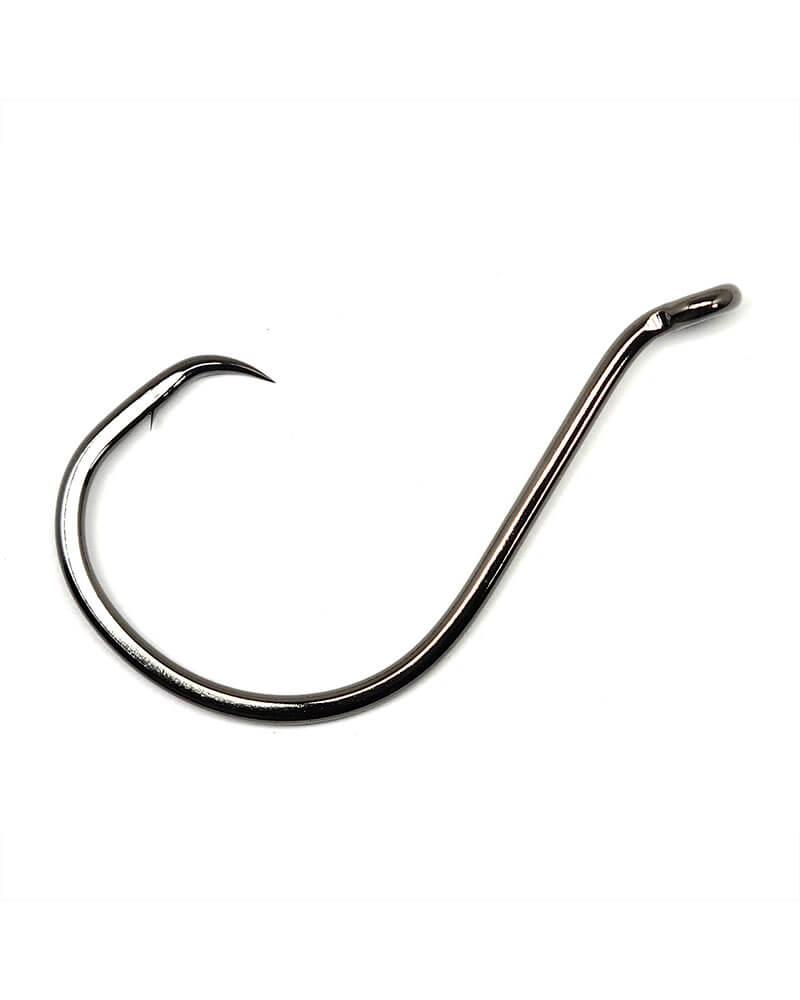
 Circle hooks are designed to hook fish differently from traditional J-style fishing hooks. Instead of having a point that extends upward toward the opening of the hook, a circle hook has a point that turns sharply back toward the shank. When a fish takes the bait and moves away, the hook is pulled forward through the mouth until the point reaches the corner of the jaw, where the hook rotates and catches.
This design makes circle hooks particularly useful for fishing with live bait, cut bait, and other natural baits. They are also widely used when fish are likely to be released because they can substantially reduce deep hooking compared with conventional J-hooks.
Circle hooks do require a different technique, however. The traditional hard hookset used with a J-hook is generally counterproductive with a circle hook. The angler needs to allow the fish to take the bait and then apply steady pressure by reeling rather than sharply pulling the rod back.
What Is a Circle Hook?
A circle hook is a fishing hook with a pronounced circular or oval bend and a point that curves inward toward the shank. On a true non-offset circle hook, the point is turned back toward the shank rather than extending straight up from the bend.
The unusual shape is intentional. A circle hook is designed to slide over the softer tissues of the throat and digestive tract as tension is applied, then rotate when it reaches the fish's mouth. The point catches the jaw, typically near the corner of the mouth.
This is fundamentally different from a conventional J-hook. A J-hook has a more open point that can catch wherever it encounters tissue when the angler sets the hook. A circle hook relies on the movement of the fish and the tension in the line to position and set the hook.
How Do Circle Hooks Work?
The most important part of understanding a circle hook is understanding what happens after the fish takes the bait.
When a fish picks up a baited circle hook, the hook may initially be well inside the fish's mouth. As the fish moves away and the line begins to tighten, the hook is pulled toward the front of the mouth.
Because the point is turned inward, it tends to slide rather than immediately catch. As the hook reaches the corner of the mouth, the pressure from the line causes the hook to rotate. The point then engages the jaw and the hook becomes firmly seated.
This is why circle hooks are often described as self-setting. The hook is not literally setting itself without pressure; rather, the geometry of the hook and the movement of the fish work together to position the hook and drive the point into the mouth.
Research and fishery surveys have found that circle hooks can substantially increase the proportion of fish hooked in the mouth rather than deeply hooked in the throat or digestive tract.
Circle Hooks vs. J-Hooks
| Feature | Circle Hook | J-Hook |
|---|---|---|
| Point orientation | Turns inward toward the shank | Generally points upward from the bend |
| Hook-setting technique | Reel steadily; avoid a hard hookset | Traditional hookset can be used |
| Typical hook location | Corner of the mouth | Can hook in various areas |
| Deep-hooking risk | Generally lower when used correctly | Generally higher when bait is swallowed |
| Common applications | Live bait, cut bait, bait fishing, catch-and-release | Broad range of bait and lure applications |
The biggest practical difference is the way the angler responds when the fish takes the bait. A J-hook is commonly set by pulling the rod back. With a circle hook, that same reaction can pull the hook away from the fish before it has rotated into the corner of the mouth.
How to Set a Circle Hook
The hardest part of fishing with circle hooks for many anglers is resisting the instinct to set the hook.
When a fish takes the bait, allow it to take the bait and move away. Once the line comes tight, begin reeling steadily. As the rod loads and pressure increases, the circle hook should rotate into the corner of the fish's mouth.
Do not make a hard upward hookset.
A sharp hookset can pull the circle hook out of the fish's mouth before it reaches the corner. Fisheries agencies specifically recommend allowing the fish to load the rod and applying steady pressure rather than striking.
This technique works particularly well when fishing from a rod holder, where the fish can take the bait and move away while the angler waits for the rod to load.
Advantages of Circle Hooks
Reduced Deep Hooking
The primary advantage of circle hooks is their tendency to hook fish in the mouth rather than deep in the throat or digestive tract. Deep hooking can cause serious internal injuries and significantly reduce the survival of released fish.
Because a properly used circle hook tends to slide toward the front of the mouth before catching, it can reduce the frequency of deep hooking compared with traditional J-hooks. This makes circle hooks particularly valuable for catch-and-release fishing.
Easier Hook Removal
A fish hooked in the corner of the mouth is generally easier to unhook than a fish that has swallowed a hook. The hook is usually visible and accessible without reaching deep into the fish's mouth or throat.
This can make releasing fish faster and reduce handling time.
Well Suited to Bait Fishing
Circle hooks work particularly well with natural bait. Live bait, dead bait, cut bait, and other bait presentations are common applications.
They are especially useful when a fish is expected to pick up the bait and move away before the angler responds. Catfish, striped bass, redfish, snapper, tuna, billfish, and other species are commonly targeted with circle hooks in various fisheries.
Useful for Rod-Holder Fishing
Circle hooks are well suited to fishing from a rod holder because the angler does not need to react with an immediate hookset. The fish's movement and the increasing tension in the line provide much of the action needed to seat the hook.
This makes them particularly useful for bottom fishing, surf fishing, catfishing, offshore bait fishing, and other situations where multiple rods may be soaking bait.
Less Dependence on Precise Hookset Timing
With a conventional hook, the timing and direction of the hookset can have a significant effect on whether the hook catches properly. Circle hooks shift some of that responsibility to the hook's geometry. The angler still needs to choose an appropriate hook, rig the bait correctly, and maintain suitable line tension, but the exact instant of the hookset is less important because the fish's movement helps position the hook.
Disadvantages of Circle Hooks
They Require a Different Fishing Technique
The biggest disadvantage for someone accustomed to J-hooks is that the normal hookset does not apply. The instinct to strike when a fish bites is strong, particularly when fishing with a sensitive rod. With a circle hook, striking can pull the hook away from the fish instead of allowing it to rotate into the corner of the mouth. There is a learning curve for anglers who are used to fishing with conventional hooks.
Not Ideal for Every Fishing Technique
Circle hooks are designed around a particular hooking mechanism. They excel when fish take bait and move away, but that does not make them the best choice for every fishing technique.
They are generally poorly suited to actively fished artificial lures where the angler needs to control the hookset. Traditional J-hooks and other hook styles are better suited to many lure presentations because the angler can immediately drive the hook into the fish when it strikes.
Bait Placement Matters
The point of a circle hook needs to remain sufficiently exposed to function properly. Burying the point deeply in tough bait can interfere with the hook's ability to rotate and catch the corner of the mouth.
Live and dead baits should generally be rigged so the hook point and gap remain available to engage the fish. Fisheries guidance recommends keeping the point exposed or using appropriate baiting and bridling techniques.
Hook Size Still Matters
A circle hook that is too small may not have enough gap to engage properly around the fish's jaw. A hook that is too large can interfere with the bait or be difficult for the fish to take.
Hook size should be matched to the bait and target fish rather than selected solely by species. The particular circle-hook pattern also matters because two hooks with the same nominal size can have different dimensions.
When Are Circle Hooks Commonly Used?
Circle hooks are most useful when fishing with natural bait and when reducing deep hooking is important.
Live Bait Fishing
Circle hooks are widely used with live bait. The bait can be presented naturally while the hook remains positioned to catch when the fish takes the bait and moves away. Live bait applications include minnows, baitfish, shrimp, crabs, and other natural baits depending on the target species and fishery.
Cut Bait
Circle hooks are also effective with cut bait. This is particularly common when targeting catfish and various saltwater species, because cut bait is often left stationary or allowed to drift while the angler waits