
Night vision in movies and television often looks remarkably clear. Characters can see across dark fields, recognize people at a distance, move through unlit buildings, and observe their surroundings through a bright green image. Real night vision can look very different. Depending on the equipment and conditions, the image may be grainy, monochrome, dark in some areas, or difficult to interpret.
These differences are not necessarily signs of a defective device. Movies use lighting, image processing, color effects, and other techniques to make nighttime scenes easier for audiences to understand. Real night vision must work with the light available to the device, the limitations of its optics and sensor, and the conditions in the environment.
Understanding what night vision can realistically show helps set better expectations when choosing equipment for wildlife observation, hunting, property observation, or other nighttime activities.
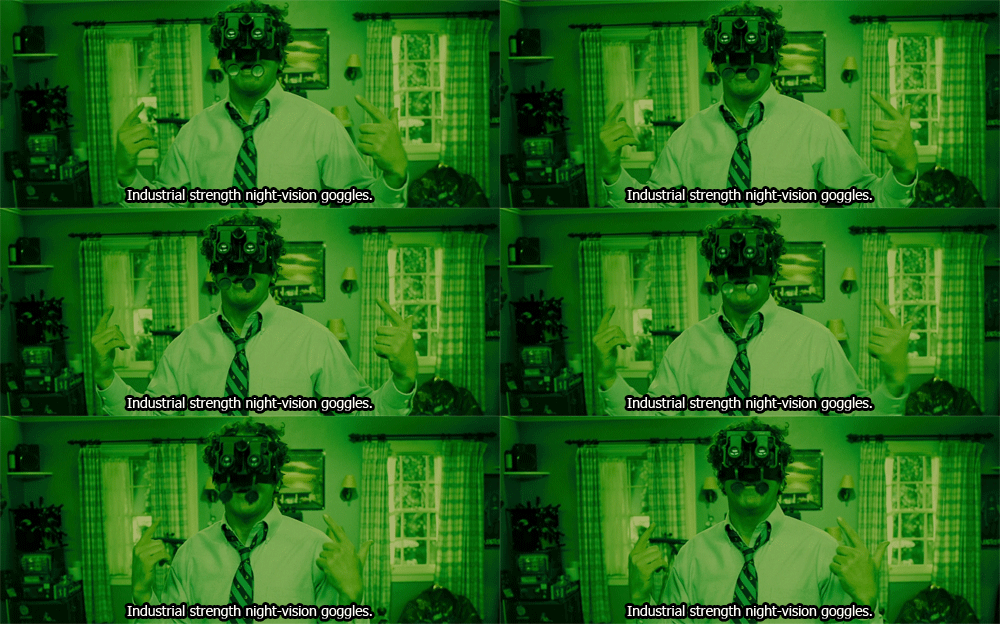 Table of Contents
- How Movie Night Vision Differs from Reality
- Why Real Night Vision Looks Grainy
- Why Night Vision Looks Green
- Why Some Areas Look Dark or Completely Black
- Why Distant Objects Are Hard to Identify
- Why Infrared Illumination Matters
- Digital Night Vision vs. Traditional Night Vision
- Night Vision vs. Thermal Imaging
- How to Get a Better Night Vision Image
- Frequently Asked Questions
How Movie Night Vision Differs from Reality
The image above is from the 2008 movie Step Brothers. The scene is not shot through night vision. It was filmed under bright lights and a green color was overlaid during the editing process.
Film and television portray night vision in ways that make scenes easier to follow. A character may enter a nearly pitch-black room and immediately see clearly from wall to wall. A distant person may appear as a sharp, recognizable figure, and the entire scene may have a consistent green tint.
Real equipment does not necessarily produce that kind of image. Night vision performance depends on the technology being used, available light, target distance, sensor sensitivity, optics, and whether infrared illumination is available.
| Movie portrayal | Real-world behavior |
| Clear images in nearly complete darkness | Image quality depends on available light or compatible infrared illumination. |
| Sharp details at long distances | Distant objects may be detectable without enough detail to identify them. |
| A uniformly bright green image | Brightness and contrast vary across the scene, and not all night vision is green. |
| Instant recognition of every object | Shadows, vegetation, distance, and low contrast can make objects difficult to interpret. |
| A stable view while moving quickly | Movement, narrow fields of view, and device handling can make observation more difficult. |
| Every heat source or person clearly visible | Thermal imaging and night vision use different technologies and have different limitations. |
Real night vision can produce excellent images under favorable conditions. The important distinction is that the device cannot guarantee a clear view regardless of the environment. A bright, detailed image in an open area may become much less useful when the subject moves into deep shadow or behind vegetation.
Why Real Night Vision Looks Grainy
Graininess is one of the most common differences between cinematic night vision and real nighttime viewing. In traditional image-intensifier systems, visible image noise is often called scintillation. Digital night vision can also display grain, speckling, and other forms of electronic image noise.
Night vision equipment is designed to work with very small amounts of light. When the available signal is weak, the image may contain variations that become visible as grain or speckles. The amount and appearance of this noise depend on the technology, equipment quality, light levels, and image processing.
Low light makes image noise more noticeable
In a brighter scene, the imaging system receives more useful light, which can help produce a clearer image. When illumination drops, the device has less information to work with. Noise can become more noticeable, and subtle differences between objects may disappear.
This is particularly relevant when observing a dark tree line, a shaded trail, or an animal standing beneath dense foliage. The device may show movement or an outline without providing a smooth, detailed image.
Digital zoom can make grain more obvious
Digital zoom enlarges a portion of an image that has already been captured. It can make a distant subject appear larger, but it also enlarges existing noise and image imperfections. As the zoom level increases, the image may look softer, more pixelated, or less detailed.
This explains why a device may show a useful image at its base magnification but produce a disappointing view at its maximum digital zoom. The subject becomes larger on the display without necessarily becoming easier to identify.
For a detailed explanation, see our guide to digital zoom vs. optical zoom in night vision.
Why Night Vision Looks Green
The familiar green night vision image comes primarily from traditional image-intensifier technology. In these systems, incoming light is converted into electrons, amplified, and converted back into visible light by a phosphor screen. A green phosphor produces the characteristic green image.
The green color does not mean that the environment itself appears green to the device. Traditional image intensifiers generally produce a monochrome image rather than a full-color photograph. The phosphor screen determines the color of the displayed image.
Not all night vision is green
Traditional image-intensifier systems are also available with white phosphor, which produces a grayscale image. The choice of phosphor affects the image's appearance, but color alone does not determine the quality or range of a night vision device.
Digital night vision works differently. It uses an electronic sensor and display, and its nighttime image may appear in grayscale, green, or other display modes depending on the device and its settings. Some digital systems also provide daytime color imaging when sufficient visible light is available.
Movies tend to use green because it is immediately recognizable as night vision. Real equipment offers more variation, and the image may not resemble the familiar cinematic effect at all.
Why Some Areas Look Dark or Completely Black
Night vision does not illuminate every part of a scene equally. The image depends on the light reaching the device, the characteristics of the target, and the surrounding environment. Areas that receive little light may remain dark even when other parts of the image are clearly visible.
Shadows and dense vegetation
A field exposed to moonlight may be relatively easy to observe, while a nearby wooded area remains much darker. Tree canopies, brush, buildings, and other obstructions can block ambient light and prevent the device from receiving useful information from a subject.
Bright areas can affect the rest of the image
Streetlights, vehicle headlights, security lights, and other bright sources can create challenging viewing conditions. Depending on the device, bright areas may produce glare, reduce visible detail nearby, or cause the image to adjust its brightness in ways that make darker areas harder to see.
Why Distant Objects Are Hard to Identify
One of the most misleading aspects of movie night vision is the apparent ability to recognize distant people, animals, and objects with little effort. In real use, detecting an object is different from recognizing or identifying it.
- Detection: Determining that an object or movement is present.
- Recognition: Determining the general type of object, such as a person, deer, or vehicle.
- Identification: Distinguishing more specific features that allow the object to be identified.
A night vision device may detect movement across a field without providing enough detail to determine whether the moving object is a deer or a person. Recognition may become possible at a shorter distance, while identifying specific features may require an even closer view.
For a more detailed explanation of detection, recognition, identification, and the factors that affect viewing distance, read our guide to how far night vision can see at night.
Target size and contrast matter
A large object is generally easier to detect at a distance than a small one. Contrast also matters. An animal that stands out against an open field may be easier to see than one whose color and outline blend into surrounding vegetation.
Magnification cannot recover missing detail
Increasing magnification can make a distant object appear larger, but the resulting image is only useful if the device has captured enough information to begin with. Optical magnification can help project a larger image onto a sensor, while digital zoom enlarges an image electronically after capture.
Why Infrared Illumination Matters
Many digital night vision devices use infrared (IR) illuminators to improve visibility when ambient light is insufficient. Infrared light is outside the visible range of human vision, but compatible night vision sensors can detect the light reflected from objects.
An IR illuminator can make a dark scene easier to observe by supplying additional illumination. However, its presence does not guarantee a perfectly clear image or unlimited viewing distance.
Infrared illumination has practical limits
The useful distance of an illuminator depends on its output, beam pattern, the sensitivity of the imaging system, and the characteristics of the target. A narrow beam may concentrate illumination over a longer distance, while a wider beam covers more of the scene.
Some night vision devices need IR more than others
Traditional image intensifiers amplify available light and can operate passively when sufficient ambient light is present. Digital night vision devices vary in their low-light sensitivity. Some can produce useful images in very low ambient light, while others depend more heavily on built-in or external IR illumination.
Digital Night Vision vs. Traditional Night Vision
Traditional image-intensifier night vision and digital night vision produce images through different processes. These differences affect image appearance, low-light performance, recording capabilities, and the situations in which each technology is useful.
| Feature | Image-intensifier night vision | Digital night vision |
| Image formation | Amplifies available light through an image-intensifier tube | Captures light with an electronic sensor and displays the processed image |
| Typical image appearance | Green or white monochrome, depending on phosphor | Grayscale, green, color, or other supported display modes |
| Infrared illumination | Can operate passively; compatible IR may supplement available light | Some models rely on IR illumination, while others can operate in low ambient light |
| Recording | Depends on the system and additional equipment | Many models offer built-in photo or video recording |
| Image limitations | Limited by available light, tube performance, optics, and conditions | Limited by sensor performance, processing, optics, light, and display characteristics |
Neither technology should be judged by image color alone. Performance depends on the specific device and the conditions in which it is used. A good comparison considers image detail, sensitivity, illumination, viewing comfort, field of view, and intended application.
Night Vision vs. Thermal Imaging
Thermal imaging is often confused with night vision because both technologies can be used to observe objects in darkness. However, they form images in fundamentally different ways.
Night vision uses available light or infrared illumination to create an image based on reflected light. Thermal imaging detects differences in infrared radiation emitted by objects and converts those differences into an image.
Thermal imaging can make a warm animal stand out against a cooler background even when visible-light night vision struggles to show it. Traditional and digital night vision, on the other hand, can provide visual detail that helps the user interpret an object's physical appearance when lighting and image quality are favorable.
How to Get a Better Night Vision Image
Although equipment has limitations, a few practical steps can improve the viewing experience.
- Use the appropriate illumination: If the device supports infrared illumination, use it when ambient light is insufficient and the situation allows it.
- Start at a lower magnification: A wider field of view makes it easier to locate subjects and follow movement. Increase magnification only when additional detail is useful.
- Adjust focus carefully: Correct focus is essential for a sharp image. Follow the manufacturer's instructions for focusing the objective lens and eyepiece, where applicable.
- Keep the lens clean: Dirt, moisture, fingerprints, and condensation can reduce contrast and sharpness.
- Use a stable viewing position: Hand movement becomes more noticeable at higher magnifications. A stable position can make observation easier.
- Account for the environment: Fog, rain, vegetation, and uneven lighting can reduce useful viewing distance.
- Understand the device's limitations: Maximum magnification and advertised range do not guarantee that distant subjects will be identifiable.
Before judging a device, try it in conditions similar to those in which you intend to use it. Observe stationary and moving targets at different distances, with and without available IR illumination if supported. This provides a more realistic understanding of the image quality you can expect.
Frequently Asked Questions
Why is my night vision grainy?
Grain can result from the amplification process in traditional image intensifiers or from electronic image noise in digital systems. Low light can make these effects more noticeable. Higher digital magnification may also enlarge existing grain and reduce perceived detail. It's worth noting that all forms of digital zoom will cause a grainy image, and the extent depends on the magnification.
Why does my night vision look black and white instead of green?
Not all night vision uses green phosphor. Traditional image-intensifier devices may use green or white phosphor, while digital devices can display images in grayscale, green, or other colors.
Can night vision really work in complete darkness?
Compatible equipment can operate in extremely dark conditions when it has a suitable source of illumination, such as an infrared illuminator. Passive systems depend on the light available to them, while digital devices differ in their sensitivity and illumination requirements.
Why can't I identify an animal even though I can see it?
Detection requires less detail than recognition or identification. Distance, target size, contrast, lighting, focus, and sensor performance can limit the detail available, even when the animal's presence is visible.
Does more expensive night vision always produce a clearer image?
Price alone does not guarantee image quality. Sensor or tube performance, optics, illumination, processing, and environmental conditions all matter.
Is digital night vision the same as thermal imaging?
No. Digital night vision captures available light or reflected infrared illumination with an electronic sensor. Thermal imaging detects differences in infrared radiation emitted by objects. The technologies serve overlapping but different purposes.
What to Expect from Real Night Vision
Real night vision can reveal activity that would otherwise be difficult or impossible to observe in darkness, but its image will not always resemble what appears in movies. Grain, dark shadows, limited detail at distance, and dependence on available light or infrared illumination are normal considerations when evaluating performance.
Explore our selection of night vision devices to find equipment for nighttime observation and outdoor use.