
Boresighting is one of the easiest ways to save time and ammunition when mounting a new scope, red dot sight, or other optic. However, many shooters make simple mistakes during the boresighting process that can lead to inaccurate results and unnecessary frustration at the range. Understanding these common errors can help ensure a smoother sight-in experience and improve the overall accuracy of your firearm.
One of the most frequent mistakes is assuming that boresighting replaces live-fire zeroing. A laser boresight is designed to align the optic closely with the rifle's bore, but it does not account for ammunition type, bullet trajectory, environmental conditions, or firearm-specific characteristics. Even the most accurate boresighter should be viewed as a starting point rather than a final zero.
Another common problem is using a low-quality or improperly aligned boresight. Many inexpensive cartridge-style boresights can fit loosely within the chamber, creating inconsistencies each time they are inserted. If the laser is not perfectly centered, the projected dot may not accurately represent the barrel's true centerline. This can result in larger corrections being required during live-fire sighting.
Poor firearm stability during the boresighting process is another overlooked issue. If the rifle shifts even slightly while adjustments are being made, the laser reference point and optic alignment can change. Using a sturdy gun vise, shooting rest, or other stable support helps maintain consistent positioning and improves boresighting accuracy.
Distance also plays an important role. Some shooters attempt to boresight at extremely short distances, such as across a small room. While this may get the optic roughly aligned, a longer distance often provides a more precise reference point. Following the boresight manufacturer's recommendations for setup distance can produce more reliable results.
Ignoring optic mounting issues can create additional problems. Loose scope rings, improperly torqued bases, or misaligned mounts can cause point-of-impact shifts even after successful boresighting. Before beginning the sight-in process, verify that all mounting hardware is secure and installed according to the manufacturer's specifications.
Many shooters also fail to check for parallax or reticle movement while making adjustments. If the shooter's eye position changes behind the scope, the reticle may appear to move relative to the target. Maintaining a consistent sight picture during boresighting helps prevent unnecessary adjustment errors.
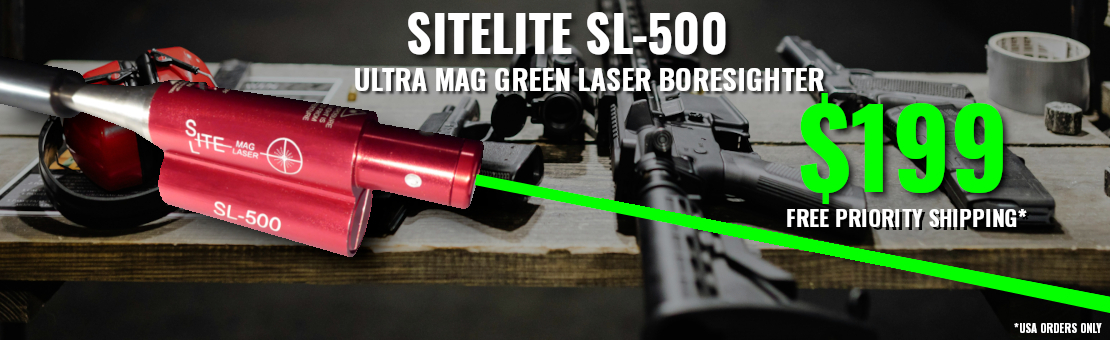
Bright outdoor conditions can create visibility challenges as well. If the laser dot is difficult to see, shooters may inadvertently align the optic to the wrong point. High-visibility green laser boresighters often provide better daylight performance and allow for more precise adjustments under varying lighting conditions.
Finally, rushing the process can lead to avoidable mistakes. Taking a few extra minutes to verify the boresight's placement, confirm optic adjustments, and double-check alignment often results in a faster and more efficient range session. A careful boresighting procedure can significantly reduce the number of rounds needed to achieve a final zero.
Wrap Up - Common Boresighting Mistakes to Avoid
- Assuming a boresight provides a final zero instead of a preliminary alignment.
- Using a low-quality boresight that does not consistently align with the rifle's bore.
- Failing to secure the firearm in a stable shooting rest or gun vise.
- Boresighting at distances that are too short to provide meaningful alignment.
- Overlooking loose scope rings, bases, or mounting hardware.
- Making adjustments while the rifle is moving or shifting position.
- Ignoring reticle movement caused by inconsistent eye placement behind the scope.
- Attempting to boresight in poor lighting conditions where the laser dot is difficult to see.
- Not verifying the boresight's position before making scope adjustments.
- Rushing the process and skipping alignment checks before heading to the range.
Key Takeaways
- A boresight helps get shots on paper faster, but live-fire zeroing is still required.
- Stable firearm support is essential for accurate boresighting results.
- Quality boresighting equipment can improve consistency and repeatability.
- Proper optic installation is just as important as the boresighting process itself.
- Taking time to verify alignment can save ammunition, range time, and frustration.
By avoiding these common mistakes, shooters can maximize the benefits of laser boresighting, save ammunition, and spend less time making large corrections at the range. Proper technique, quality equipment, and attention to detail all contribute to a more accurate and efficient sight-in process.